port
Siemens Design Award, 1st place · 2020
Partners Marvin Bruns, Till Troll, Christopher Kötting, Patrick Schneider · Organization B/S/H Group & FH Potsdam
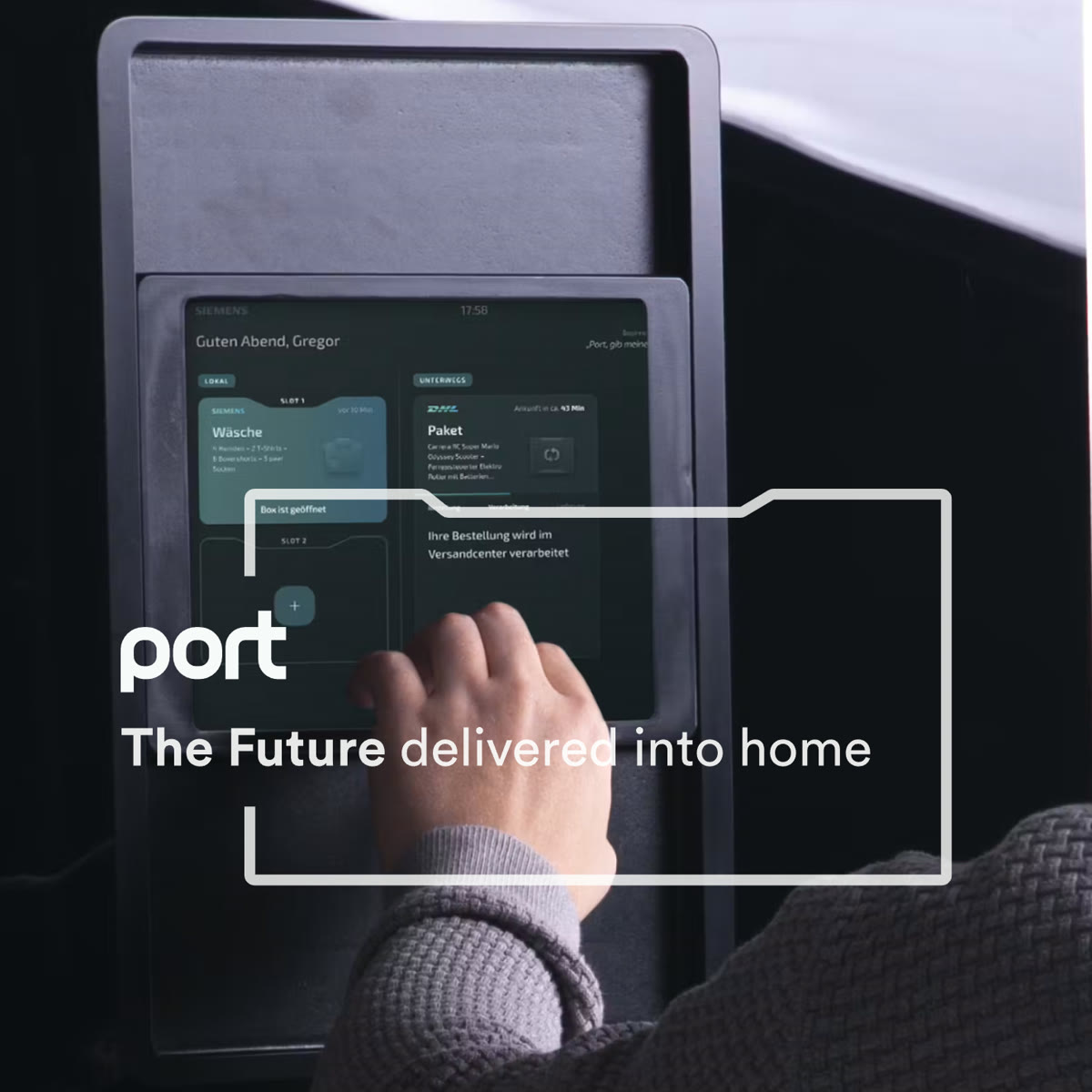
Port is a concept for a future infrastructure. With port, transporting goods through town is pretty much erased from above ground: everything that fits in a 60 × 40 × 35 cm box can be delivered by port.
Houses, flats and logistics centres are connected underground, which makes it possible to get anything you need in a matter of minutes. Beyond deliveries, that could also mean trying on new shoes or sharing all kinds of things with friends and family.
All you need is a box
The core of port is the box and the ecosystem around it. Like today's delivery vans, the boxes are used, returned into the cycle every day, and adapt to what they're needed for. That opens up completely new possibilities for e-commerce, and it relieves an infrastructure that was never built for the amount of goods traffic we have today.
How it works
The delivery network works like a forgotten 19th-century technology: the pneumatic tube. In the future, our goods travel on an underground rail network built for exactly this, from warehouses, logistics centres and markets to our homes, and back.
Reinventing the postbox
Port started at the end of 2019 from a simple observation: the demand for deliveries is too high to cover long term with traditional infrastructure. Discovering tube mail sparked the idea. For weeks we discussed tunnel systems, services and how such a system could be established over 30 years.
We quickly realised we had to express the idea through the people using it, so we started prototyping. What would it be like to get dinner, a bottle of wine, a pair of trousers or toilet paper within five minutes, just a tap away?
Our »scenario 2050« assumes a fully underground network. To get there, we designed a hybrid for »scenario 2030«: the pipelines are still supplied by traditional delivery traffic, but unlike today they can deliver and receive at any time.
From nomination to prototype
For the application video we pooled all our skills. Till's 3D models were staged in Blender, edited in Premiere and finished in After Effects. Three days later the video was done, and we were nominated.
That let us build what we'd hoped for: a realistic, testable prototype of port, from the UI and the drawers to the box with its unusual display. We had five weeks and five designers with very different skill sets.
The box's built-in display was the hardest part. It wasn't really available on the market, had no documentation, and the signal transmission had to be worked out from scratch in very little space. I had never done anything like it, but after nights of research and trial and error it worked within two weeks. Special thanks to Illtis & Wiesel, who sold us a sample after what felt like hundreds of emails and calls.
Because of the pandemic, the final was held online. Together with two other projects from our university we made the podium, and port took first place.